A version of this article appeared in The Scots Magazine in June 2022
Scotland’s glens are famed across the world; from the drama of Glen Coe to the tranquillity of Glen Trool, the majesty of Glen Lyon to the brooding atmosphere of the Great Glen.
But tucked away in the far north west reaches of the mainland is an often forgotten glen steeped in history, heritage and scenery. Dunbeath Strath in Caithness is scarcely visited compared to its cousins further south but it is undoubtedly one of the best in the country.
Neil Gunn was born in Dunbeath in 1891 and his masterpiece Highland River is set along the 12 miles of Dunbeath Water – a sculpture above the harbour marks him and the work. The novel follow’s the route to the river’s source – Loch Braigh na h-Aibhne, below the remote, conical summit of Morven. It is a tough undertaking as much of it is pathless, although it does take you into a wilderness of moorland and mountain which is usually home only to eagles and deer.
Much more manageable is the three or four miles to the edge of the seemingly endless hinterland.
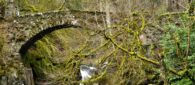
Leaving the harbour and village behind, you pass an Iron Age broch, dating back 2,500 years – it is also home to an impressive show of wild primroses in spring. Then comes Prisoner’s Leap Gorge where it is said Ian McCormack Gunn leapt to his freedom after being captured by the Keiths. Windswept moorland follows with the ruins of Loedebest, a village left deserted by the Clearances. Eventually, you reach the white-walled cemetery, Tutnaguail, standing isolated and looking similar to those seen in a Clint Eastwood Western film.
Further up the strath the going gets harder underfoot but it is worth exploring a little further to get a taste for remote, trackless country. This is truly a place which is “in the middle of nowhere” and somewhere to stop and admire the desolate beauty of this part of Scotland.
You may not see many people on an exploration of this glen (or strath) but you will certainly experience some wonderful scenery and history. And you are almost certain to get a picnic spot (of which there are numerous ones along the way) all to yourself.
Had a good day up Ben Vorlich from the side of Loch Earn at the weekend. A great, straightforward path all the way up making it a perfect one for beginner Munro baggers! It is, however, big enough for all the stages of a proper mountain walk. In my case they are:
In the car on the way – “Weather looks a bit cloudy, maybe I’ll do something easier.”
After getting out of the car – “I can feel a tweak in my calf, maybe I’ll just walk part of the way.”
30 mins after starting – “Everyone else on the path seems to be walking faster than me.”
45 mins after starting – “My lungs are bursting, maybe I need to work on fitness before I do a walk like this.”
An hour after starting – “That top section looks like a bit of a difficult scramble, maybe I will just go to the bottom of it.”
Closer to the top – “My lungs are feeling huge, I could walk all day.”
Nearly at the top – “I feel fit, even though I’m a bit tired.”
Just below the summit – “This top section is fine, just a steep path, don’t know what I was worrying about.”
At the summit – “Made the top! I feel great!”
5 mins later – “Oh, the cloud has come down and it’s raining, but I wouldn’t want to be anywhere else!”
I think it is always good to have in mind that walking up mountains and hills can be hard work – even for super-fit gym bunnies who decide the great outdoors is just an extension of the treadmill or rowing machine.
But that doesn’t mean it is not enjoyable and, gym-bunnies aside, you don’t have to charge up and down to a summit as quickly as possible. If a guide says it takes five hours it doesn’t matter if you take eight because you have lingered over a view, soaked aching feet in a burn, watched a red kite soaring above (and then a hen harrier, and a buzzard), or simply walked slowly to enjoy the sounds of bubbling burns, the wind on moorland grass or the feel of sun on your face.
The length of walk matters if you want to judge whether you have enough stamina but it is not a time you have to keep to, you are not booked on it for a set amount of time.
As I admitted above, I am guilty of putting pressure on myself to complete a walk but it would be better if we took the attitude that we are going on a wander and although the final destination may be a summit, it is the getting there that is the real fun element – so we should take our time. And, if we don’t get to the top, it doesn’t matter (we normally will but if we have gone up with lots of stress about weather, calf muscles, other people we won’t enjoy it as much as we could).
Finally, if you see someone charging up a hill, admire their fitness by all means but think about what they are missing out on by going so fast.
Scotland’s landscapes are praised across the world, a hugely important environmental resource and the most vital part of the tourism industry which helps power the country’s economy.
So why does the current Scottish Government prefer to look the other way? It has just finished a consultation on the National Planning Framework but in the draft proposals wild land is not identified as being a “nationally important asset”.
The Scottish Wild Land Group has found that our precious landscapes and ecosystems are under threat because of increasing development on and near areas designated as “Wild Land”.
In its recent report The State of Wild Land in the Scottish Highlands it found planning decisions were inconsistent, allowing the ever-expanding number of wind turbines to increasingly impact (some would say ruin) the surrounding environment.
Wind turbines are good in the sense that they help reduce carbon emissions in the production of energy, and planting trees is a good thing as they trap carbon. But if the consequence of this is to damage the environment the developments are meant to protect it doesn’t seem to make sense.
The economy is often thrown in as a justification – we need a secure, clean energy supply and we need to invest for both environmental and economic reasons.
But if those developments start to put off visitors their overall aims will have failed. Visitors are important, whether from overseas or simply staycationers travelling from the Central Belt to the Highlands, because tourism accounts for around one in every 12 jobs in Scotland and has been described by the Scottish Government as a “cornerstone” of the economy.
The tourists come in large numbers to enjoy Scotland’s iconic landscapes so when there are warnings that they are under threat, we should take notice.
And this is not a new problem, it is something that should have been addressed a long time ago. In 2018, the then chief executive of the John Muir Trust Andrew Bachell told me: “This is a creeping industrialisation of bits of our landscape. In a sense the cause of the conflict is that there has never been, within Scottish Government, a policy of looking after our landscapes.
“The public interest in having landscapes well looked after should not have been something we had to campaign on case by case, it should have been a founding principle behind an industrial change. As a country we have sailed close to the wind.”
The Scottish Government now has a chance to do something positive and protect the wild land of Scotland. Let us hope it takes the chance and doesn’t continue to look the other way.
Credit: Michal Klajban, CC BY-SA 4.0, via Wikimedia Commons
If you drive around Scotland you might be forgiven for thinking the country is well-connected – good roads lead you all over the mainland. Sometimes there is a queue or cancellation of a ferry but if you are on holiday it just gives more time to explore the harbour, take some pics and find some seafood to eat.
The phone signal will cut out, or not work properly and children in the back of the car may complain they can’t download a film or watch YouTube. No matter, the trip is about enjoying the scenery so look out of the window and admire the view, or step outside and go for a splodge in a burn.
Increasingly I think that, as well as staycationers from the Central Belt and beyond, that is also the viewpoint of decision makers in Edinburgh and London. But try living, working or running a business with these problems.
Despite years of hearing from the Scottish Government about millions of pounds of investment it appears ferry services are close to non-existent at times and the broadband network north of Perth is woeful.
A couple of weeks ago The Ferries Community Board said CalMac’s West Coast Ferries were so badly operated that there was a “threat to island life”. An ageing fleet regularly succumbs to breakdowns and therefore cancellations. There is also a lack of new ferries due to come into service and the ones that are due are still not built only adds to the chaos.
Angus Campbell, chairman of the board which puts forward islanders’ views on ferry services, said: “While we are well used to living with the effects of weather on our ferry services, and more recently Covid, the recent extent and duration of mechanical failures on multiple vessels has led to massive disruption across the network.
“Unfortunately this is unlikely to be a one-off with such an ageing fleet in our challenging environment. This represents a real threat to our islands’ ability to retain and attract people, ensure services are sufficiently reliable and at prices that permit viable communities and thereby avoid depopulation.”
Worryingly, he adds: “Without a fit for purpose ferry service, all efforts to sustain and grow population, encourage new business and provide equality of opportunity will be increasingly damaged – to the detriment of our islands and our country.”
Transport Scotland, part of the Scottish Government, said it recognised a “lack of confidence” in CalMac services. It is not a lack of confidence, it is a realisation that the services are no good. The Holyrood administration is also keen to point to £580m of investment in infrastructure. Governments do spend money but reason for that is to make the country’s infrastructure work better – in this case they are failing.
If the Scottish Government says there is investment in ferries but a farmer or fisherman on the islands cannot guarantee their perishable product will get to market on time because the service is so poor, that is not good enough after yeas and years of the issues being known about and acknowledged.
Meanwhile, the Scottish Government is failing on a pledge made in 2017 to deliver superfast fibre broadband to all homes by 2021, having delayed completion until 2026/27.
On Tiree, the community broadband provider, says a lack of fibre cable mean islanders are left with poor internet speeds. Tiree Community Broadband says “it is forced to juggle multiple domestic copper lines” to provide a service to their customers because Openreach refuses to provide Tiree Broadband with direct access to a fibre connection.
TCB’s chairperson, Rhoda Meek, told the Oban Times: “We are once again forced to try and upgrade our network to cover the lack of basic provision. Unfortunately, we have reached the end of the road with sticky tape and string solutions.
“The island exchange is about 20 metres away from our network access point, complete with a connecting duct, and yet we are unable to access a full fibre service. It is frustrating to say the least.”
Openreach said they “understand the frustrations” and were looking for a “viable answer”. Maybe lay a bit of fibre down and upgrade the equipment?
And if the Scottish Government are so keen to have superfast broadband for everyone – surely they could find the cash to lay the cable. It is hard to imagine a similar situation being allowed to continue for a long time in Edinburgh.
The news that an estate in the Highlands has lost part of its general licence to cull birds after a golden eagle was found dead and poisoned is yet another chapter in the never-ending battle against wildlife crime. Some say it is nearly impossible to win the fight, such is the difficulty in finding the actual perpetrators. Others say it is time to crack down more forcefully and bring an end to killing animals for enjoyment.
But if sporting estates don’t find a way to tackle the illegal persecution of birds and mammals, even if they are not guilty of it themselves, they could face a grim future in which restrictions and public opposition make it difficult to continue their centuries-old country pursuits. In turn, that could pose a threat to rural communities who rely on employment from estates.
I’m not opposed to field sports, I’ve been deer stalking – with a gun and with a camera. I preferred using a camera for my shots as it was the thrill of getting close to the majestic stag which excited me. The actual killing I couldn’t in any way say I enjoyed; there was more a sense of relief in getting a clean shot – the quickest and least traumatic death possible.
Many gamekeepers will say the same thing. They will also point to the fact that we do need to kill red deer in Scotland if we have any chance of keeping the numbers down – without the wolves which once roamed the glens there are no predators and huge numbers of deer are no good for the natural habitats our eco-system relies on. The argument is not about whether to cull but how many, and while I don’t like the idea of killing animals I’m aware it needs to be done.
Then there are the paying clients the gamekeepers, stalkers and ghillies take on to the hills and mountains to stalk and shoot. These clients help keep fragile rural economies surviving – take them away and the estate will see job losses, the local town and village will see a loss of revenue from accommodation, restaurants, pubs, shops, then people will move away to look for work, schools will be under threat with lower numbers etc etc.
Some say the dawning of eco-tourism, re-wilding and other forms of diversification would help replace jobs centred around field sports. Yes, they would, but not the same number of jobs in many cases. A big estate can diversify in a number of ways, keeping job numbers up. A smaller estate may only take on afforestation instead of stalking – once the trees are planted, the position of three former keepers would be replaced with that of possibly one ranger / forester.
But if the deer need culling, surely there will always be a job for a stalker? Not according to an article in Scottish Field which found Forestry and Land Scotland – the Scottish Government agency responsible for more land than anyone – are employing large contractors to carry out culling, with independent, often local, gamekeepers finding it difficult to get the work.
So, we need our estates to thrive, for the economy and for the environment. But while that may be true there is still a large body of public opinion against field sports, and while stories of illegal wildlife persecution continue the pressure to clamp down on them will only grow. Which is why it seems estates have to do some self-policing of their own.
Police Scotland resources are overstretched, other public agencies likewise, meaning there cannot be a continual presence in the glens, looking for wrongdoing. Estates cannot patrol their land constantly either, but they are better placed than anyone to know what is going on.
In the latest case of general licence restriction, the Invercauld Estate, a “neighbour to the Queen” at nearby Balmoral, points out it has not been accused of poisoning the dead golden eagle found on its land last year. While NatureScot, which issues licences, said: “The decision was made on the basis of evidence provided by Police Scotland of wildlife crime against birds. This evidence included a poisoned golden eagle found on the estate in March 2021, along with a rabbit and a hare carcass, both baited with poison.”
When other estates have had restrictions on the use of general licenses imposed because of evidence of wildlife crime on their land they too have said they are not responsible for any illegality. It has also been claimed that a poisoned bird can fly on to an estate.
While this is all true, it seems that if the estates don’t know, how can anyone else be expected to. Maybe there needs to be some honest behind-the-scenes discussion and activity between estates to come up with a solution to solving the problem.
If they don’t the future of Scotland’s rural estates may be a lot different than many would wish, and harmful to rural communities.
Pic credit: Lairich Rig / Tom Weir statue: detail, CC BY 2.0, via Wikimedia Commons
Tom Weir was a world-class climber and mountaineer who was among the first to explore the previously forbidden ranges of Nepal in the post-war years. But he also had as much enthusiasm for Scotland and his long-running STV series Weir’s Way introduced millions to the beautiful scenery, wonderful stories and amazing walks to be enjoyed just beyond their doorsteps.
It is the latter that I have most admiration for, the ability to stay grounded about everything in the natural environment and not become aloof because you have climbed arduous routes that had been thought inaccessible. Tom Weir’s contribution to the outdoors in the second half of the 20th century cannot be underestimated, and is why he is an obvious choice for this series on Scottish pioneers of the outdoors.
Weir was born in Springburn, Glasgow, in 1914 – the son of a locomotive fitter. Like many of his generation he was among the first working-class climbers and walkers to escape the industrialisation of home for the glens and mountains to the north. At first this would be in the Campsies and the Trossachs but catching a night train to the Highlands would also be on the young man’s itinerary.
One formative destination would be the Craigallion fire, a gathering place for climbers and walkers below the Campsies. This was somewhere to sit around a fire and talk all things outdoors – like-minded folk learning from each other about where to best experience the outdoors.
Weir served with the Royal Artillery during World War Two and later became a surveyor with the Ordnance Survey. But it was mountains that really held his interest and before long his ability was noticed and in 1950 he was part of the first post-war Himalayan expedition. Climbing would also take him to Greenland, Norway, and Kurdistan, among many other countries.
To supplement his income he wrote many books and in 1976 began recording Weir’s Way for STV. It ran until 1987 and won him a Scottish Television Personality of the Year Award. When I moved to Scotland in 1998 the programmes were shown on repeat and even 20 years after being made were a great introduction to the history, landscapes, mountains, glens and coast of Scotland, as well as the people who live here. I was not alone in enjoying them and feel that without his enthusiasm and knowledge many may never have discovered the hidden gems which are all over this country.
He also wrote a column for The Scots Magazine for many years, championing the environment and Scotland’s landscapes, cementing his place as one of the most authoritative voices on the outdoors.
Weir died aged 91 in 2006 near the shores of Loch Lomond, where he lived for many years, and a statue now stands in his memory at Balmaha. Many may have thought of him as “that man with the bobble hat on telly” but he was much more than his personality – he was a driving force for public recognition of Scotland’s natural environment. Read about the other Scottish outdoor pioneers in the series – Nan Shepherd, Hamish MacInnes and John Muir – more to follow in the coming weeks!
I am a journalist whose love of the outdoors and all things rural has seen me walking the highest Munros, eating Scottish seafood in Singapore, stalking deer with a camera and just about everything imaginable in between... Find out more...