The Edinburgh Natural History Society were recently kind enough to ask me to guide them on a walk around 38 hectares very close to my home, and my heart.
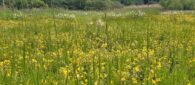
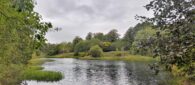
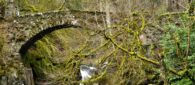
The biodiverse site on the edge of Linlithgow links heath land, woodland, a large pond (known locally as The Lagoon) and the River Avon.
It was once a sand quarry (until 2000) but has seen a large amount of re-wilding thanks to tree planting and I am part of a campaign to save it from housing developers who are being invited to buy it by the former quarriers. Learn more about that at our Facebook page – Green Battle Linlithgow.
So, with the forecast promising a fairly dry day, a dozen of us set off. After explaining the history of the site – which stretches back nearly 500 years as it was where the Battle of Linlithgow Bridge took place – I then made a plea to find a rare moth, beetle or plant that would stop any house building. It was a plea in hope rather than expectation because what I was really hoping to do was learn more about this place I have a deep affection for.
And right away I was learning; who knew how many insects live on plants, every single plant?
To say the walk was long would be wrong; the route I had chosen is one I have done many times and I would allow around an hour, and I think of myself as a relatively slow walker (it is the best way to see things).
By the standard of my companions however, I was an Olympic sprinter. Such was their dedication to study the plants and animals that the walk was to take close to five hours, but a really good five hours.
The Edinburgh Natural History Society says on its website: “Mosses, birds, insects, flowers, trees, sea-life, fungi, mammals and much more – we’ve got them covered.”
And importantly for me it adds: “Field trips are focussed on what is found on the day and there are generally a number of specialists to share their expertise. There is no fear in asking about the very common such as a daisy, you will also gain knowledge less commonly known.”
My big learning was how much life is on a tree. Those little balls, or bits of minute fungi are galls – and they might contain insects, bacteria, fungi or viruses.
Oak trees were a favourite place to see them – apparently, they can be home to wasps, and the oak apple gall is quite big and does look like an apple, making it easy to spot. But because of the other creatures and organisms it means that “normal” tree is home to more things than Edinburgh Zoo.
Slowing down is a great thing to do whether you are looking for a golden eagle or an aphid. Previously I would look in the middle distance to increase my chances of seeing birds or mammals but on this day I was crouching down and peering under leaves.
More than 100 species were recorded in total, from hoverflies to an unusual sedge (Carex spicata) to birds and mammals. But for me it was spending a long, time in one place that really fascinated me, allowing time to really explore everything, big and small.
I was sent a list of all the birds which had been seen and heard which probably really illustrates just how much nature there is in a relatively small place.
Birds seen: mute swan, mallard, moorhen, buzzard, magpie, carrion crow, jay, wood pigeon and robin
Birds heard: dabchick, chaffinch, willow warbler, blackcap, chiffchaff, treecreeper, wren, blackbird, song thrush, skylark and pheasant
As we made our way back to the promise of coffee at the end of the walk, I realised I had been well and truly educated. Obviously, I knew nature provides a rich, diverse and fascinating bounty to enjoy. But to have my eyes opened to this apparently never-ending array of life had been extraordinary, especially as much of it had been there all the time, it just took a group of enthusiasts to point it out to me.
Unfortunately, none of this actually helps stop housing development if a builder were to buy the land and apply for permission. It seems that some species are more important than others and some biodiversity is more important than others.
We will, however, continue our fight to save Linlithgow’s biggest accessible green and blue space for the benefit of the flora and fauna, as well as the walkers, cyclists, wild swimmers, anglers and nature lovers.
It would be nice to think that an area so biodiverse, which is loved and used by a range of people – both locals and those who travel to it from across the Central Belt – would be deserving of protection from those who come up with rules and regulations. That may be viewed by “pen pushers” and some large companies as a rather incongruous view but I believe it is how many people actually look at the world they live in, even the tiniest parts of it.
The Scottish Government has slashed spending on the environment, again (it always seems that when money is tight the environment suffers first).
This time it is the very important Nature Restoration Fund that has gone. This fund, worth £29.2m, is used by councils and environment agency NatureScot to help local projects to combat the crisis in nature, from tree planting to restoring waterways.
But the Scottish Government has redirected £5m to fund public sector pay offers. They say the money will be returned to fund nature restoration, one day. But it is not a good look for a country already struggling to combat climate change and loss of nature – whether that be reaching targets or giving the environment a greater priority.
It does seem that the only way we in Scotland can protect the environment properly is by doing it ourselves.
I have written before about how myself and a friend are trying to protect an area of great biodiversity very close to my home in Linlithgow. And, how I have realised I am now a (very peaceful) eco-warrior read more here.
The area we are trying to save from housebuilding is 14.3 hectares in size and ranges from a river bank, a lagoon, marsh and heath land, and lots of woodland.
Why are we doing this? Well, to cut a long story short it was once a sand quarry and the owners used grants (funded by public money) to plant loads of trees and do some quite successful rewilding (before that was a popular word).
Then, when the time limit on conditions for the grants was up, they put it up for sale to housebuilders. That is where we come in – we don’t want the land to be built on, we want it left as it is. That means as a thriving haven for nature which is enjoyed by locals and visitors alike.
If successful that means we will have helped preserve nature for the future following a period of nature restoration.
But here we also have the problem of Government and priorities. The local council assigned the land as not for housing but when the owners appealed the “experts” at the Scottish Government decreed housebuilding was ok. That sounds like the priority was not nature. Cutting the Nature Restoration Fund is just a continuation of this approach. And the publicly funded grants which helped a sand quarry be restored to nature are also tainted with the same attitude; an initial priority on nature but not long-lasting.
So, we are doing it ourselves, pushing to get wildlife surveys done so we can get some kind of designation such as a Local Nature Reserve – not a priority for the Scottish Government.
If you would like to support us, please go to our Facebook page
I have written before about how and myself and a friend are trying to protect an area of great biodiversity very close to my home in Linlithgow. And, how I have realised am now a (very peaceful) eco-warrior read more here.
The area we are trying to save from housebuilding is 14.3 hectares in size and ranges from a river bank, a lagoon, marsh and heath land, and lots of woodland.
The woodland is home to a variety of wildlife, but exactly what we can’t say with absolutely certainty unless we see it. In come mammal cameras – hi-tech stuff which will take pics day and night when ever some goes past.
The kind folk at MammalWeb! have leant us a couple – but where to put them? Not near paths or where the public might go – some don’t like the idea of being filmed. So, a bit of exploring has been necessary.
When we set up Green Battle Linlithgow (read our Facebook page to find out more) I thought it would mainly be talking to people, trying to persuade them. I have been delighted to realise before you can do that you need to spend a lot of time outside, working out precisely what you are talking about.
So far, we have mapped the area by walking around on obvious paths, permitted and informal. Recently we have had to go into the woods to find somewhere to put the cameras.
My eyes have been opened further to just how wonderful nature is, less than a mile from my house. Once you get to just inside the woods, away from oaths, and look at how far ahead they spread there is a sense of awe.
This is actually a vast space where humans rarely go, usually only to look for a missing dog – and even then, only a short way in. After just a few minutes exploring I have found myself enjoying a genuine feeling of being “in the middle of nowhere”.
Previously this sensation had been in the mountains or the wild open spaces of the Far North of Scotland. Now, I have found it much closer to home.
To know there is this space, busy and bustling (from what we can see on the cameras) when there are no humans around is affirming and makes me think of our space in the world. Yes, we dominate as a species (often in a bad way) but it is good to be reminded that we are far from everywhere, even in the Central Belt of Scotland.
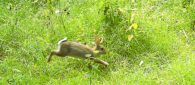
Watch this space to find out about all the animals we have found. But even to see rabbits and foxes mooching about, relaxed and unbothered by humans, is a treat.
I have always been concerned about the need to protect the environment and preserve nature for the benefit of plants and wildlife, and sometimes humans.
But I never thought of myself as an eco-warrior, until now.
About 18 months ago my friend and I decided to launch a campaign to save a patch of land where we live in Linlithgow, West Lothian. It had been a sand quarry until 2000 and since then the owners, Cemex, had planted loads of trees which encouraged a good degree of re-wilding. Locals and visitors alike enjoy walking, cycling and swimming in a tree-fringed lagoon, created as a result of the quarrying. There is also the chance for bird-spotting while enjoying the banks of the River Avon.
However, Cemex have the land up for sale to property developers – despite the local council designating the land as not for housing, they were over-ruled by the Scottish Government (it seems the need for luxury housing supersedes nature).
We wanted to do something but didn’t like the idea of being a “proper” campaign, ie “constituted” with secretaries, board members etc. We just wanted to do our bit.
So, with the help of planning experts in the town, and the community council, we have prepared objections to stop any housebuilder bringing in the diggers.
But we are realistic and accept that will only delay the builders as the Scottish Government are usually on their side if they appeal a local decision.
So, we have brought in biodiversity experts from universities, and the council. This means we can collect the data needed to prove that the site is technically worthy of a designation which would stop buildings – a Local Nature Reserve would be great, if we find a great-crested newt, a Site of Special Scientific Interest would be even better.
We have the support of lots of people in the town, using social media to spread the word, and best of all – posters.
Another friend designed posters which it has been my task to put up around the town, inviting folk to download a QR code to an app where they can record all the brilliant things in nature you can see in Kettil’stoun Woodland, by the Avon Lagoon and down to the river. This data helps the scientists do their research, which in turn helps us prove the site deserves to be properly protected.
When your head is fuzzy and full of too much stuff at the end of a day’s work, going and doing something positive is a great antidote. And there is nothing better for me than putting up the posters.
It means I get to walk around the beautiful site, speak to people who stop to ask what I am doing (usually leaving them fully signed up to our aims) and have a feeling that I am “doing my bit”.
For me, being an eco-warrior is not about chaining myself to trees or causing disruption, it is about doing the best I can to help preserve nature for the benefit of all. And posters are the best bit.
Find out more about our campaign at our Facebook page
Sir Chris Bonington. Credit – thecreativegrid, CC BY 3.0, via Wikimedia Commons
A version of this article appeared in The Scots Magazine in March 2022
After more than a year of waiting for the right conditions, Sir Chris Bonington and his partner Ian Clough embarked on the toughest challenge they had ever attempted.
They were to become the first Brits to complete the perilous route of more than 5,000ft up the North Wall of the Eiger.
Bivouacking overnight on the face, they eventually made it to the summit of a mountain Bonington describes in his book Ascent as “an amphitheatre that focuses all your fears”.
But with the laidback attitude found in many elite climbers he recalls the events of 60 years ago: “It was very much a snatched opportunity. I had made several earlier attempts but for one reason or another had turned back.
“This time the conditions seemed perfect and so at the end of the season I persuaded Ian Clough to go with me and it all went amazingly smoothly.
“We had been climbing all that summer and as a result I was physically fit and acclimatised.”
The Eiger has been called the “Killer Mountain” and two other climbers died on the same day. And, Ian Clough, a Yorkshireman, was to die in 1970 on an expedition to the South Face of Annapurna in the Himalayas. It was led by Bonington and he would later describe him as “the kindest and most selfless partner I ever had”.
But it was not the biggest event of that year for Sir Chris – he met his wife Wendy at a 12th night party and they married in the May, he then gave up a lucrative job with Unilever to pursue his love of climbing.
His career in mountaineering opened up after the climb up the North Wall of the Eiger; Bonington says it was the largest media coverage he ever received for a climb, including the successful expedition to Everest which he led in 1975 when Doug Scott and Dougal Haston became the first Brits to reach that summit.
His love of climbing began when he was 16 and still at school in London. In those early years he hitchhiked all the way Scotland, eager to find rock faces, crags and boulders to test out his growing skills, meeting for the first time Hamish MacInnes, who was rather suspicious of the young lad from Hampstead. They would however go on to team up on climbs across the world, as well as pioneering some routes on Buachaille Etive Mor above Glencoe
It wasn’t long before he looked further afield and started to explore the Alps. And by 1960, now commissioned in the Royal Tank Regiment, he was in the Himalayas, a member of the Joint British-Indian-Nepalese Services Expedition and part of team which made the first ascent of Annapurna II (7,937 metres).
The 1975 Everest expedition was one of the most notable achievements of Bonington’s life, even though he didn’t make the top because storms had left the mountain prone to avalanche when his summit team was due to climb up. The worldwide coverage did, however, cement his place among the climbing greats, alongside Dougal Haston from Currie near Edinburgh and Doug Scott from Nottingham. Bonington had climbed with Haston before, notably on an expedition up the South Face of Annapurna in 1970, when Ian Clough lost his life. After Haston died in a ski-ing accident in 1977 Bonington said he acutely felt his loss “as a good friend and like-minded climbing partner”.
Although he hadn’t managed to reach the summit he would return to Everest with a Norwegian expedition in 1985 and stand on top of the world.
His love of Scotland continued from those early years and he has climbed across the country. He says: “It’s where I do a lot of my climbing for the sheer fun and thrill of it, and because the Highlands have such scale and beauty with their sea lochs and variety of mountains.”
But he is perhaps best known for making the first ascent of the of The Old Man of Hoy, off Orkney, in 1966 with Scottish climber Tom Patey and Rusty Baillie. He describes it as “the most remarkable sea stack in the British Isles”.
He returned the following year with a large team of climbers for a live television broadcast, with the filming led by Hamish MacInnes – his climbing by now had made him a star of the times.
But maybe the most difficult time he had was when he returned once more to celebrate his 80th birthday – again with a TV film crew. He describes it as “challenging”, adding: “I had hoped to lead at least one pitch but in the event was very glad to have a top rope all the way up. I don’t think I shall be tempted to try again for my 90th!”
Although he found that climb, and others, difficult, he is not someone who worries about fear too much. He says: “If there is a crisis whilst climbing you are too busy getting out of it and staying alive to be scared because it’s important that you stay cool. Fear is a very healthy response and feeling because it reminds you that it is dangerous and therefore important to stay cool.”
Bonington is still climbing at the age of 87 (he is 88 in August 2022). Much of his time is also taken up with charity work, including Community Action Nepal, which helps mountain communities in the country, and the MND Association. His first wife, Wendy, died of motor neurone disease in 2014 and he says the charity gave her “a huge amount of support”.
EIGER FACTFILE
The Eiger, meaning ogre, is a 3,967-metre peak in the Swiss Alps.
The first people to reach the top were Swiss guides Christian Almer and Peter Bohren and Irishman Charles Barrington. IN August 1858 they went up the western side.
The North Wall was seen as the “last problem” of the Alps and was first climbed by an Austrian-German team in 1938.
It is one of the most dangerous mountains in Europe and has claimed the loves of more than 60 climbers.
Climbing on the North Wall is normally done in the morning during summer as rockfalls increase in the afternoon when the air temperature rises.
A German nickname for the North Wall is Mordwand, “murder wall”.
The Jungfrau Railway uses a tunnel through the mountain, complete with viewing-windows carved into the rock face.
Legendary Scottish climber Hamish MacInnes worked as an advisor and safety officer for the 1975 blockbuster movie the Eiger Sanction, starring Clint Eastwood.
The house of a pioneering Scottish artist has been saved for the nation after a last-ditch funding appeal saw mystery benefactors come forward. The Tim Stead Trust had almost given up hope of raising the £450,000 needed to buy the late artist’s home in the Borders. The house, which is filled with the Stead’s experiments in wood – even a wooden sink – had gone on the open market when the anonymous benefactors stepped in.
Tim Stead, founder of Britain’s first community woodland and the artist behind works such as the National Museum of Scotland’s Millennium Clock, died of cancer in 2000 at the age of 48. His widow, Maggy, wished to return to her native France but could not afford to keep their home – The Steading, near the small village of Blainslie – as a cultural hub.
It was due to go on the open market after a fundraising campaign struggled to meet the huge amount needed but the Tim Stead Trust has announced that with a “significant number of major pledges and donations”, finished off with help of a Crowdfunder campaign, the target of £450,000 has been reached.
The funds will allow the Tim Stead Trust to purchase The Steading for the nation and begin an ambitious programme of restoration, renovation and development.
Now, phase two of fundraising is about to begin in order to turn the home into a cultural and education centre.
The good news comes as the culmination of a roller-coaster journey for the Trust, which began a major fundraising campaign over a year ago. In November, following the refusal of The National Heritage Memorial Fund to award a major purchase grant, the Trust’s hopes were severely dashed. However, within days a major benefactor stepped up and offered matched funding up to £250,000. This was swiftly followed by a number of major private donors and trusts, and within a few weeks the majority of necessary funds had been secured. The Crowdfunder campaign, launched only a week ago, raised £20,000 with donations from over 240 individuals.
The Tim Stead Trust has ambitious plans to develop The Steading as a major international centre for “wood culture” which embraces Tim Stead’s all-round vision for the environment, art, literature, wood-working and architecture. The Steading is envisaged as a centre for education and creativity, reflecting its unique place in the Scottish Borders, but with a global reach.
Maggy Stead, Tim’s widow, said “It is a huge relief to me to know that my Tim’s work will now be preserved and used in such a creative way. He would have loved that.”
Unlike his public work, such as the North Sea Oil Industries Memorial Chapel in Aberdeen created in 1989 and the chair made for Pope John Paul’s visit in 1981, this was a private family house where the couple brought up their children Sam and Emma. But it is also a shrine to Tim’s work and his experiments in wood.
Sam Stead, Tim’s son and a Trustee, said: “It is fantastic that we have managed to get to the point where The Steading can be bought by the Trust and start working on opening it up for the public. The amazing support from friends and fans of my father’s work has been truly heart-warming.”
Stead, originally from Cheshire, came to Scotland in 1975 as a post-graduate at the School of Art in Glasgow. He met Maggy, also studying in Glasgow, four days before she was due to leave Scotland – they fell in love at first sight and were married a year later.
Nichola Fletcher, Chair of the Trust, added: “We are overwhelmed by the speed of this response, and with the enthusiasm that our project has sparked. We are so grateful to our supporters, who have given so generously. The past two months has turned me into a fund-raising junkie so I’m not stopping now! We have urgent restoration work to do and of course we have ambitious plans for The Steading. So now the real work begins, of fundraising for Phase 2 of the project, which will allow us to realise our dream of developing The Steading into a major centre for creativity and education.”
His style of working with wood, celebrating its natural beauty, is so fashionable now, it was actually pioneering at the time.
Initially he used pieces salvaged from a Glasgow hardwood importers – the bed in the couple’s bedroom, complete with a knobbly, multi-coloured topped chest, is from wood destined for a bonfire – but a move to the Borders ignited a passion for native wood.
Café Gandolfi in Glasgow was one of his first public works, the Millennium Clock one of his last, created in conjunction with several artists including Eduard Bersudsky, who now runs the Sharmanka Kinetic Theatre in Glasgow but who lived in a nearby cottage when he first arrived from Russia in 1993. One of Bersudsky’s characteristic pieces – ornate shelves – graces the house, a testament to the time when the house buzzed with art students and collaborators. Stained glass around the house was made by local artists, the kitchen table was created by Tim from a slice of a massive stump of burr elm spotted by the couple’s chimney sweep while up on the roof.
To find out more about the house and the ongoing fundraising, visit www.timsteadtrust.org
I am a journalist whose love of the outdoors and all things rural has seen me walking the highest Munros, eating Scottish seafood in Singapore, stalking deer with a camera and just about everything imaginable in between... Find out more...