The Edinburgh Natural History Society were recently kind enough to ask me to guide them on a walk around 38 hectares very close to my home, and my heart.
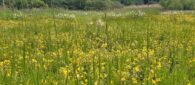
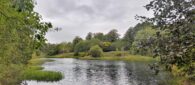
The biodiverse site on the edge of Linlithgow links heath land, woodland, a large pond (known locally as The Lagoon) and the River Avon.
It was once a sand quarry (until 2000) but has seen a large amount of re-wilding thanks to tree planting and I am part of a campaign to save it from housing developers who are being invited to buy it by the former quarriers. Learn more about that at our Facebook page – Green Battle Linlithgow.
So, with the forecast promising a fairly dry day, a dozen of us set off. After explaining the history of the site – which stretches back nearly 500 years as it was where the Battle of Linlithgow Bridge took place – I then made a plea to find a rare moth, beetle or plant that would stop any house building. It was a plea in hope rather than expectation because what I was really hoping to do was learn more about this place I have a deep affection for.
And right away I was learning; who knew how many insects live on plants, every single plant?
To say the walk was long would be wrong; the route I had chosen is one I have done many times and I would allow around an hour, and I think of myself as a relatively slow walker (it is the best way to see things).
By the standard of my companions however, I was an Olympic sprinter. Such was their dedication to study the plants and animals that the walk was to take close to five hours, but a really good five hours.
The Edinburgh Natural History Society says on its website: “Mosses, birds, insects, flowers, trees, sea-life, fungi, mammals and much more – we’ve got them covered.”
And importantly for me it adds: “Field trips are focussed on what is found on the day and there are generally a number of specialists to share their expertise. There is no fear in asking about the very common such as a daisy, you will also gain knowledge less commonly known.”
My big learning was how much life is on a tree. Those little balls, or bits of minute fungi are galls – and they might contain insects, bacteria, fungi or viruses.
Oak trees were a favourite place to see them – apparently, they can be home to wasps, and the oak apple gall is quite big and does look like an apple, making it easy to spot. But because of the other creatures and organisms it means that “normal” tree is home to more things than Edinburgh Zoo.
Slowing down is a great thing to do whether you are looking for a golden eagle or an aphid. Previously I would look in the middle distance to increase my chances of seeing birds or mammals but on this day I was crouching down and peering under leaves.
More than 100 species were recorded in total, from hoverflies to an unusual sedge (Carex spicata) to birds and mammals. But for me it was spending a long, time in one place that really fascinated me, allowing time to really explore everything, big and small.
I was sent a list of all the birds which had been seen and heard which probably really illustrates just how much nature there is in a relatively small place.
Birds seen: mute swan, mallard, moorhen, buzzard, magpie, carrion crow, jay, wood pigeon and robin
Birds heard: dabchick, chaffinch, willow warbler, blackcap, chiffchaff, treecreeper, wren, blackbird, song thrush, skylark and pheasant
As we made our way back to the promise of coffee at the end of the walk, I realised I had been well and truly educated. Obviously, I knew nature provides a rich, diverse and fascinating bounty to enjoy. But to have my eyes opened to this apparently never-ending array of life had been extraordinary, especially as much of it had been there all the time, it just took a group of enthusiasts to point it out to me.
Unfortunately, none of this actually helps stop housing development if a builder were to buy the land and apply for permission. It seems that some species are more important than others and some biodiversity is more important than others.
We will, however, continue our fight to save Linlithgow’s biggest accessible green and blue space for the benefit of the flora and fauna, as well as the walkers, cyclists, wild swimmers, anglers and nature lovers.
It would be nice to think that an area so biodiverse, which is loved and used by a range of people – both locals and those who travel to it from across the Central Belt – would be deserving of protection from those who come up with rules and regulations. That may be viewed by “pen pushers” and some large companies as a rather incongruous view but I believe it is how many people actually look at the world they live in, even the tiniest parts of it.
The Scottish Government has slashed spending on the environment, again (it always seems that when money is tight the environment suffers first).
This time it is the very important Nature Restoration Fund that has gone. This fund, worth £29.2m, is used by councils and environment agency NatureScot to help local projects to combat the crisis in nature, from tree planting to restoring waterways.
But the Scottish Government has redirected £5m to fund public sector pay offers. They say the money will be returned to fund nature restoration, one day. But it is not a good look for a country already struggling to combat climate change and loss of nature – whether that be reaching targets or giving the environment a greater priority.
It does seem that the only way we in Scotland can protect the environment properly is by doing it ourselves.
I have written before about how myself and a friend are trying to protect an area of great biodiversity very close to my home in Linlithgow. And, how I have realised I am now a (very peaceful) eco-warrior read more here.
The area we are trying to save from housebuilding is 14.3 hectares in size and ranges from a river bank, a lagoon, marsh and heath land, and lots of woodland.
Why are we doing this? Well, to cut a long story short it was once a sand quarry and the owners used grants (funded by public money) to plant loads of trees and do some quite successful rewilding (before that was a popular word).
Then, when the time limit on conditions for the grants was up, they put it up for sale to housebuilders. That is where we come in – we don’t want the land to be built on, we want it left as it is. That means as a thriving haven for nature which is enjoyed by locals and visitors alike.
If successful that means we will have helped preserve nature for the future following a period of nature restoration.
But here we also have the problem of Government and priorities. The local council assigned the land as not for housing but when the owners appealed the “experts” at the Scottish Government decreed housebuilding was ok. That sounds like the priority was not nature. Cutting the Nature Restoration Fund is just a continuation of this approach. And the publicly funded grants which helped a sand quarry be restored to nature are also tainted with the same attitude; an initial priority on nature but not long-lasting.
So, we are doing it ourselves, pushing to get wildlife surveys done so we can get some kind of designation such as a Local Nature Reserve – not a priority for the Scottish Government.
If you would like to support us, please go to our Facebook page
I have written before about how and myself and a friend are trying to protect an area of great biodiversity very close to my home in Linlithgow. And, how I have realised am now a (very peaceful) eco-warrior read more here.
The area we are trying to save from housebuilding is 14.3 hectares in size and ranges from a river bank, a lagoon, marsh and heath land, and lots of woodland.
The woodland is home to a variety of wildlife, but exactly what we can’t say with absolutely certainty unless we see it. In come mammal cameras – hi-tech stuff which will take pics day and night when ever some goes past.
The kind folk at MammalWeb! have leant us a couple – but where to put them? Not near paths or where the public might go – some don’t like the idea of being filmed. So, a bit of exploring has been necessary.
When we set up Green Battle Linlithgow (read our Facebook page to find out more) I thought it would mainly be talking to people, trying to persuade them. I have been delighted to realise before you can do that you need to spend a lot of time outside, working out precisely what you are talking about.
So far, we have mapped the area by walking around on obvious paths, permitted and informal. Recently we have had to go into the woods to find somewhere to put the cameras.
My eyes have been opened further to just how wonderful nature is, less than a mile from my house. Once you get to just inside the woods, away from oaths, and look at how far ahead they spread there is a sense of awe.
This is actually a vast space where humans rarely go, usually only to look for a missing dog – and even then, only a short way in. After just a few minutes exploring I have found myself enjoying a genuine feeling of being “in the middle of nowhere”.
Previously this sensation had been in the mountains or the wild open spaces of the Far North of Scotland. Now, I have found it much closer to home.
To know there is this space, busy and bustling (from what we can see on the cameras) when there are no humans around is affirming and makes me think of our space in the world. Yes, we dominate as a species (often in a bad way) but it is good to be reminded that we are far from everywhere, even in the Central Belt of Scotland.
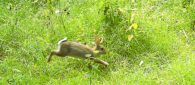
Watch this space to find out about all the animals we have found. But even to see rabbits and foxes mooching about, relaxed and unbothered by humans, is a treat.
I have always been concerned about the need to protect the environment and preserve nature for the benefit of plants and wildlife, and sometimes humans.
But I never thought of myself as an eco-warrior, until now.
About 18 months ago my friend and I decided to launch a campaign to save a patch of land where we live in Linlithgow, West Lothian. It had been a sand quarry until 2000 and since then the owners, Cemex, had planted loads of trees which encouraged a good degree of re-wilding. Locals and visitors alike enjoy walking, cycling and swimming in a tree-fringed lagoon, created as a result of the quarrying. There is also the chance for bird-spotting while enjoying the banks of the River Avon.
However, Cemex have the land up for sale to property developers – despite the local council designating the land as not for housing, they were over-ruled by the Scottish Government (it seems the need for luxury housing supersedes nature).
We wanted to do something but didn’t like the idea of being a “proper” campaign, ie “constituted” with secretaries, board members etc. We just wanted to do our bit.
So, with the help of planning experts in the town, and the community council, we have prepared objections to stop any housebuilder bringing in the diggers.
But we are realistic and accept that will only delay the builders as the Scottish Government are usually on their side if they appeal a local decision.
So, we have brought in biodiversity experts from universities, and the council. This means we can collect the data needed to prove that the site is technically worthy of a designation which would stop buildings – a Local Nature Reserve would be great, if we find a great-crested newt, a Site of Special Scientific Interest would be even better.
We have the support of lots of people in the town, using social media to spread the word, and best of all – posters.
Another friend designed posters which it has been my task to put up around the town, inviting folk to download a QR code to an app where they can record all the brilliant things in nature you can see in Kettil’stoun Woodland, by the Avon Lagoon and down to the river. This data helps the scientists do their research, which in turn helps us prove the site deserves to be properly protected.
When your head is fuzzy and full of too much stuff at the end of a day’s work, going and doing something positive is a great antidote. And there is nothing better for me than putting up the posters.
It means I get to walk around the beautiful site, speak to people who stop to ask what I am doing (usually leaving them fully signed up to our aims) and have a feeling that I am “doing my bit”.
For me, being an eco-warrior is not about chaining myself to trees or causing disruption, it is about doing the best I can to help preserve nature for the benefit of all. And posters are the best bit.
Find out more about our campaign at our Facebook page
A version of this article appeared in The Scots Magazine in May 2022
Scotland has an amazing coastline and some of the most stunning beaches in the world – yes, the world. It might not be as warm as some places people jet off to but staycationers and visitors are treated to some wonderful stretches of sand, backed by rugged landscapes.
As a result, some places can get busy, especially in holiday periods, so it is always good to know of an out of the way place where the scenery is top class but the number of people is low. And remember, a beach in winter is a wonderful place when high winds and rough seas allow the wilder side of nature to be observed.
Lunan Bay on the coast of Angus is just such a place. It is a huge expanse of sand stretching two miles between low cliffs, backed by sand dunes and the ruins of a 12th century castle which was built to repel Norsemen. The invaders landed here in 1010 and went on to sack Dundee which led to the fortification being built for King William (the Lion) of Scotland. Things are more tranquil now but there are still plenty of activities to enjoy.
As with any beach, it is perfect for a visit with a bucket and spade and a bit of a paddle. Because of its size, there will always be a quiet spot to build the best sandcastle ever seen.
Others may prefer to explore the little caves at the base of rocky cliffs at the north end (take care to avoid an incoming tide). Another activity is to hunt for semi-precious stones and agates which are found around here, especially after a storm has blown away the top layer of sand.
Then there is the wildlife. Gannets, terns, mergansers, long-tailed ducks, scoters, red-throated divers, cormorants, and shags can all be seen here while in the water you may spot a bottlenose dolphin or a porpoise. Also in the water are surfers – even in winter they brave the icy temperatures to catch a good wave.
So if you are looking for a beautiful, quiet beach with plenty to keep you occupied, give Lunan Bay a go.
The carved stone otter at raiders road otter pool picnic site in Galloway Forest Park
A version of this article appeared in The Scots Magazine in April 2022
The Otter Pool has to be one of the best out of the way swimming, paddling and photogenic spots in Scotland. It is also a great place for a picnic, games on the grassy banks and a stopping point on a walk or cycle through this backwater amid the Galloway hills.
Skye’s Fairy Pools are rightly considered a good place to head on a sunny day but this is no second best alternative. In the spring and summer months you can reach it by car along the 10-mile Raiders’ Road Forest Drive and at anytime on foot or mountain bike.
The first thing that hits you when you stop there is the quiet – you really are in the back of beyond. Although there is a car park (and toilets in the summer) even reaching it by vehicle is an adventure on unsurfaced tracks.
Forestry and Land Scotland have taken a non-intrusive approach to looking after it. A couple of wooden picnic tables are all that you will see before reaching a broad swathe of grass, some clumps of heather and, on the edge of the forest, the bubbling River Dee.
It is almost as if the stretch of water has been designed with maximum enjoyment for all ages in mind. Little ones can splodge in the shallows in their wellies, while older ones may venture further onto rocks which stretch across the river like stepping stones.
Below these rocks are a series of small rapids which at first sight look fearsome but are actually perfect for sliding down (a wetsuit is handy for some cushioning here). Beyond the rapids the river stretches on and is good for swimming while upstream is a slow-moving stretch, ideal on a sunny day for splashing about or simply to lie back and float, gazing up at the sky.
For those walking or cycling to this point, don’t think of the The Otter Pool as a quick place to stop, make time to explore it and take a towel because you will want to get at least your feet wet.
I am a journalist whose love of the outdoors and all things rural has seen me walking the highest Munros, eating Scottish seafood in Singapore, stalking deer with a camera and just about everything imaginable in between... Find out more...